
Nicola Barbieri
Ph.D. in PhysicsPostdoctoral Researcher at IFIC, Valencia
Hello! My name is Nicola Barbieri, and I am currently a postdoctoral researcher in the Astroparticle and High Energy Physics group at the Instituto de Física Corpuscular (IFIC) in València (ES). Before joining IFIC, I spent a few months as a research fellow at the Istituto Nazionale di Fisica Nucleare (INFN) in Ferrara (IT). I earned both my Bachelor's and Master's degrees at the University of Padova and later obtained my Ph.D. from the University of Ferrara, under the supervision of Dr. Massimiliano Lattanzi and Dr. Martina Gerbino.
My research lies at the intersection between particle physics and cosmology. I aim to exploit the Universe as a laboratory to test physics beyond the Standard Model (BSM), probing scenarios that may be difficult to access through terrestrial experiments. In recent years, the cosmic microwave background (CMB) has provided many remarkable results, and even more precise measurements are expected in the coming years. At the same time, a wealth of new data from both established and emerging cosmological observables is on its way. This calls for a strong effort from the theoretical community to carefully investigate the phenomenology of different scenarios and the methodological aspects of their analysis, ensuring that we are ready to make the most of the upcoming data. This is the broader picture in which I try to contribute through my daily research.
Since the early days of my Master's degree, I have been fascinated by the peculiar role neutrinos have played in the history of the Universe, as well as by the compelling evidence they represent for BSM physics. This initial interest soon led me to explore a broader range of questions, investigating the phenomenology of new physics in the earliest moments of the Universe. My work has focused primarily on the CMB and the large-scale structure (LSS) of the Universe, drawing on tools from statistical mechanics and quantum field theory.
I put this website together to share my research activities and a few other things, hopefully with a more personal touch than what you might find through official channels. The website is still very much a work in progress, but I hope you enjoy exploring it!
Research interests
Inflation & large-scale structure
Inflationary physics describes how quantum fluctuations generated during the primordial stages of the Universe were stretched to cosmological scales, providing the initial seeds for all cosmic structures. Their imprints are encoded in the subsequent evolution of the Universe, particularly in the dynamics of structure formation. Therefore, LSS offers a unique opportunity to investigate the physics of the primordial Universe and constrain the mechanisms that shaped its initial conditions.
Particle cosmology
Study of the interplay between particle physics and the evolution of the early Universe, with a focus on how new particles, interactions, and physical processes BSM may have shaped its thermal and expansion dynamics. From the production and decoupling of new particle species to non-standard cosmological eras and alternative thermal histories, these scenarios can leave distinctive imprints on cosmological observables, providing a unique opportunity to probe fundamental physics.
Neutrino physics
As proven by flavour oscillations and the still-open question of the origin of their masses, neutrinos offer a unique window into fundamental interactions and physics BSM. Cosmology provides a complementary laboratory to investigate their properties, as their abundance and interactions in the early Universe have left characteristic imprints on CMB and the LSS of the Universe.
CMB physics
CMB represents one of the most powerful probes of the early Universe, providing an exceptionally precise snapshot of its physical conditions at the time of recombination. Its temperature and polarization anisotropies encode a wealth of information about the composition, dynamics, and primordial initial conditions of the Universe. Beyond establishing the standard cosmological model, the CMB offers an unprecedented opportunity to test new physics.
These are the topics that have shaped my research so far, but the list is not closed. If you have an idea that lies off this map, I would be happy to hear it!
News
$tail -n 5 news.log
- talkPLATEAU, Asiago
- talkNOW 2026, Otranto
- talkCOSMO 2026, Leiden
- talkPASCOS 2026, Sheffield
- paperarXiv:2605.30236 · JCAP 10 (2026) 024
$
publications
Papers & preprints
Papers and preprints, newest first, with citation data from INSPIRE-HEP.
In numbers
- Papers
- 5
- 4 with 10 authors or fewer
- Citations
- 773
- 155 per paper on average
- h-index
- 5
- h papers cited at least h times
- i10-index
- 3
- papers cited at least 10 times
* to 12 Nov
Computed from INSPIRE-HEP for the papers listed below. Updated 12 Nov 2026.
2026
-
astro-ph.CO
Abstract
We investigate the presence of primordial oscillatory features in measurements of CMB anisotropies through a systematic comparison of phenomenological templates. Building upon previous searches for primordial features using Planck data, we compare the full PR3 legacy release with the PR4 (NPIPE) processing to assess how the results depend on the choice of CMB maps and likelihood framework. To maximise our sensitivity to rapidly varying oscillatory signals, we employ unbinned likelihoods. We find that several previously reported indications of oscillatory structure persist across different analyses, although none attains global statistical significance. Furthermore, some anomalies reported in earlier studies are substantially reduced when updated to the new versions of the CamSpec likelihood using Planck PR4 products. For all templates considered, we identify a small number of frequencies in the range $ω\sim 10-100$ that improve the fit to the CMB data by up to $Δχ^2 \simeq -10$ to $-15$ relative to the featureless reference model. However, this improvement is not supported by a Bayesian model comparison. The inclusion of three or four additional parameters can reduces the overall predictability of the feature models and leads to an Occam penalty. Finally, after properly accounting for the look-elsewhere effect, the significance of the preferred frequencies is reduced, corresponding to a global statistical significance of at most $2.6σ$. We present forecasts for forthcoming CMB experiments, highlighting the decisive role of next-generation polarisation measurements in distinguishing genuine primordial oscillations from statistical fluctuations and modelling systematics. The upper bounds or uncertainties on the feature amplitudes, expected from the combination of SO and LiteBIRD, improve by more than one order of magnitude.
5 citations -
astro-ph.CO · hep-ph
Abstract
We derive updated cosmological bounds on light axion-like particles (ALPs) coupled to leptons or photons, using a full phase-space treatment of their production from the primordial thermal plasma. The ALP phase-space distribution, obtained by solving the momentum-dependent Boltzmann equation for the relevant production processes, is consistently propagated into the computation of cosmological observables, allowing us to assess the impact of non-thermal spectral distortions on the effective number of relativistic species, $ΔN_{\rm eff}$. Using state-of-the-art measurements of the cosmic microwave background from Planck, the Atacama Cosmology Telescope, and the South Pole Telescope, complemented with Big Bang Nucleosynthesis determinations of primordial deuterium and helium abundances, we obtain the following 95% credible limits on the ALP decay constant: $f_a > 1.63 \times 10^6 \, {\rm GeV}$, $9.41 \times 10^6 \, {\rm GeV}$ and $8.06 \times 10^4 \, {\rm GeV}$ for ALPs coupled to electrons, muons and taus, respectively. For the ALP-photon coupling we find $g_{aγ} < 1.98 \times 10^{-8} \, {\rm GeV}^{-1}$. Including baryon acoustic oscillation data from the Dark Energy Spectroscopic Instrument mildly relaxes the constraints, in line with previous analyses of extra relativistic degrees of freedom. Finally, we present forecasts for the LiteBIRD$+$Simons Observatory and LiteBIRD$+$CMB-HD configurations, discussing the importance of an exact phase-space treatment for robust cosmological bounds on ALP interactions.
8 citations
2025
-
astro-ph.CO · gr-qc · hep-ph
Abstract
We use new cosmic microwave background (CMB) primary temperature and polarization anisotropy measurements from the Atacama Cosmology Telescope (ACT) Data Release 6 (DR6) to test foundational assumptions of the standard cosmological model and set constraints on extensions to it. We derive constraints from the ACT DR6 power spectra alone, as well as in combination with legacy data from Planck. To break geometric degeneracies, we include ACT and Planck CMB lensing data and baryon acoustic oscillation data from DESI Year-1, and further add supernovae measurements from Pantheon+ for models that affect the late-time expansion history. We verify the near-scale-invariance (running of the spectral index $d n_s/d\ln k = 0.0062 \pm 0.0052$) and adiabaticity of the primordial perturbations. Neutrino properties are consistent with Standard Model predictions: we find no evidence for new light, relativistic species that are free-streaming ($N_{\rm eff} = 2.86 \pm 0.13$, which combined with external BBN data becomes $N_{\rm eff} = 2.89 \pm 0.11$), for non-zero neutrino masses ($\sum m_ν< 0.082$ eV at 95% CL), or for neutrino self-interactions. We also find no evidence for self-interacting dark radiation ($N_{\rm idr} < 0.134$), early-universe variation of fundamental constants, early dark energy, primordial magnetic fields, or modified recombination. Our data are consistent with standard BBN, the FIRAS-inferred CMB temperature, a dark matter component that is collisionless and with only a small fraction allowed as axion-like particles, a cosmological constant, and the late-time growth rate predicted by general relativity. We find no statistically significant preference for a departure from the baseline $Λ$CDM model. In general, models introduced to increase the Hubble constant or to decrease the amplitude of density fluctuations inferred from the primary CMB are not favored by our data.
684 citations -
astro-ph.CO
Abstract
We present a comprehensive analysis of the effects of models with very low reheating scenarios ($T_\text{RH} \sim \mathcal{O}(\text{MeV})$) on the cosmological observables and derive corresponding bounds on the reheating temperature. With respect to previous work, our study includes a more precise computation of neutrino distribution functions, leveraging the latest datasets from cosmological surveys. We perform a joint analysis that combines constraints from Big Bang Nucleosynthesis, the Cosmic Microwave Background, and galaxy surveys, alongside separate investigations of these datasets, carefully assessing the impact of different choices of priors. At the $95\%$ confidence level, we establish a lower bound on the reheating temperature of $T_\text{RH} > 5.96 \; \text{MeV} $, representing the most stringent constraint to date.
62 citations
2024
-
astro-ph.CO
Abstract
Primordial oscillatory features in the power spectrum of curvature perturbations are sensitive probes of the dynamics of the early Universe and can provide insights beyond the standard inflationary scenario. While these features have been the focus of extensive studies using cosmic microwave background anisotropy data, large-scale structure surveys now provide competitive constraints with the opportunity to probe their effects at smaller scales with higher precision. In this paper, we present a complete description of the nonlinear model for primordial oscillatory features in the context of time-sliced perturbation theory extending the results already presented in the literature. We derive analytical expressions including novel contributions such as the mixed term between primordial oscillations and baryon acoustic oscillations, and we also calculate the corrections arising from the specific envelope of the oscillatory pattern, corresponding to a scale-dependent amplitude. These results are compared with N-body simulations using the COLA method and show consistent behaviour across different scales. Although the corrections are found to be small, they represent an important step to fully characterising the nonlinear imprints of primordial features on the matter power spectrum. Our results offer new calculations to be tested with future cosmological surveys that seek to detect these subtle signatures in the matter distribution.
14 citations
No papers match this filter yet.
talks
Presenting the work
Talks and posters at conferences and workshops, the meetings and schools I took part in, and where they all took place.
2026
-
Plenary talk
Neutrino thermalization in very low reheating cosmologies
PLATEAU, Particle Legacies Accumulated Through the Early Anisotropic Universe,
-
Parallel talk
Neutrino thermalization in very low reheating cosmologies
NOW 2026, Neutrino Oscillation Workshop,
-
Parallel talk
Neutrino thermalization in very low reheating cosmologies
COSMO 2026, 29th International Conference on Particle Physics & Cosmology,
-
Parallel talk
Beyond thermal approximations: Precise cosmological bounds on Axion-Like Particles
PASCOS 2026, 31st International Symposium on Particles, Strings, and Cosmology,
2025
-
Parallel talk
Current constraints on cosmological scenarios with very low reheating temperatures
TeVPA 2025,
-
Poster
Updated cosmological constraints on thermally-produced axion-like particles
TeVPA 2025,
-
Attended
New Physics from Galaxy Clustering, Focus Week,
-
Plenary talk
Updated cosmological constraints on thermally-produced axion-like particles
Axions in Stockholm,
-
Plenary talk
Current constraints on cosmological scenarios with very low reheating temperatures
New Frontiers in Theoretical Physics, XXXVIII Convegno Nazionale di Fisica Teorica,
-
Plenary talk
Current constraints on cosmological scenarios with very low reheating temperatures
IberiCos 2025, 19th Iberian Cosmology Meeting,
2024
-
Plenary talk
Refining the nonlinear modelling of primordial oscillatory features
New Physics from Galaxy Clustering III,
-
Plenary talk
Neutrinos in very low reheating scenarios
Neutrino Frontiers, Focus Week,
-
Poster
Polarized CMB Boltzmann hierarchy from non-standard neutrino interactions
Neutrino 2024, XXXI International Conference on Neutrino Physics and Astrophysics,
-
Attended
6th Magnificent CEvNS Workshop,
2023
-
Plenary talk
Polarized CMB Boltzmann hierarchy from non-standard neutrino interactions
New Frontiers in Theoretical Physics, XXXVII Convegno Nazionale di Fisica Teorica,
-
Attended
Cosmic WISPers, 1st General Meeting of the COST Action,
-
School
GGI Lectures on the Theory of Fundamental Interactions,
2022
-
Attended
Fisica Teorica all’INFN tra passato, presente e futuro,
-
Attendedonline
The Complexity of the Cosmos, an interdisciplinary symposium in cosmology, astrophysics and statistical mechanics
-
Attendedonline
YOUNGST@RS, Shoot for the Stars, Aim for the Axions
-
Attended
PADUA, Particle Avenues in the Dark Universe Arena: Axions,
-
Attended
From Planck to the Future of CMB,
-
School
Theoretical Aspects of Astroparticle Physics, Cosmology and Gravitation, GGI school,
-
Schoolonline
SIGRAV International School on Cosmology: from theory to observation
2021
code
Open-source tools
Tools I write for my own research and share. They are free to use and documented; bug reports and suggestions are welcome.
Tools
-

Inspect and plot cosmological MCMC chains, with a desktop interface and a command line.
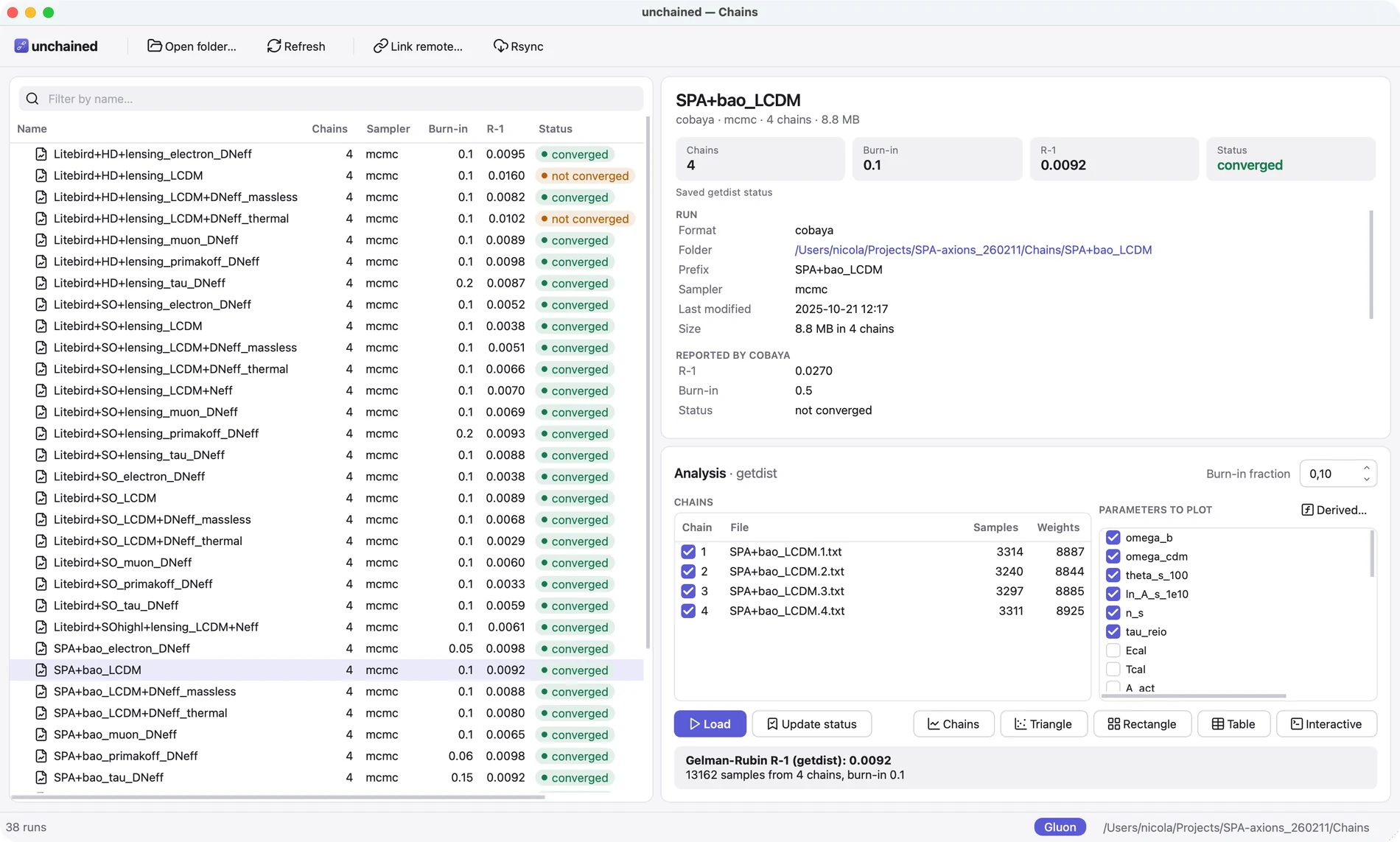
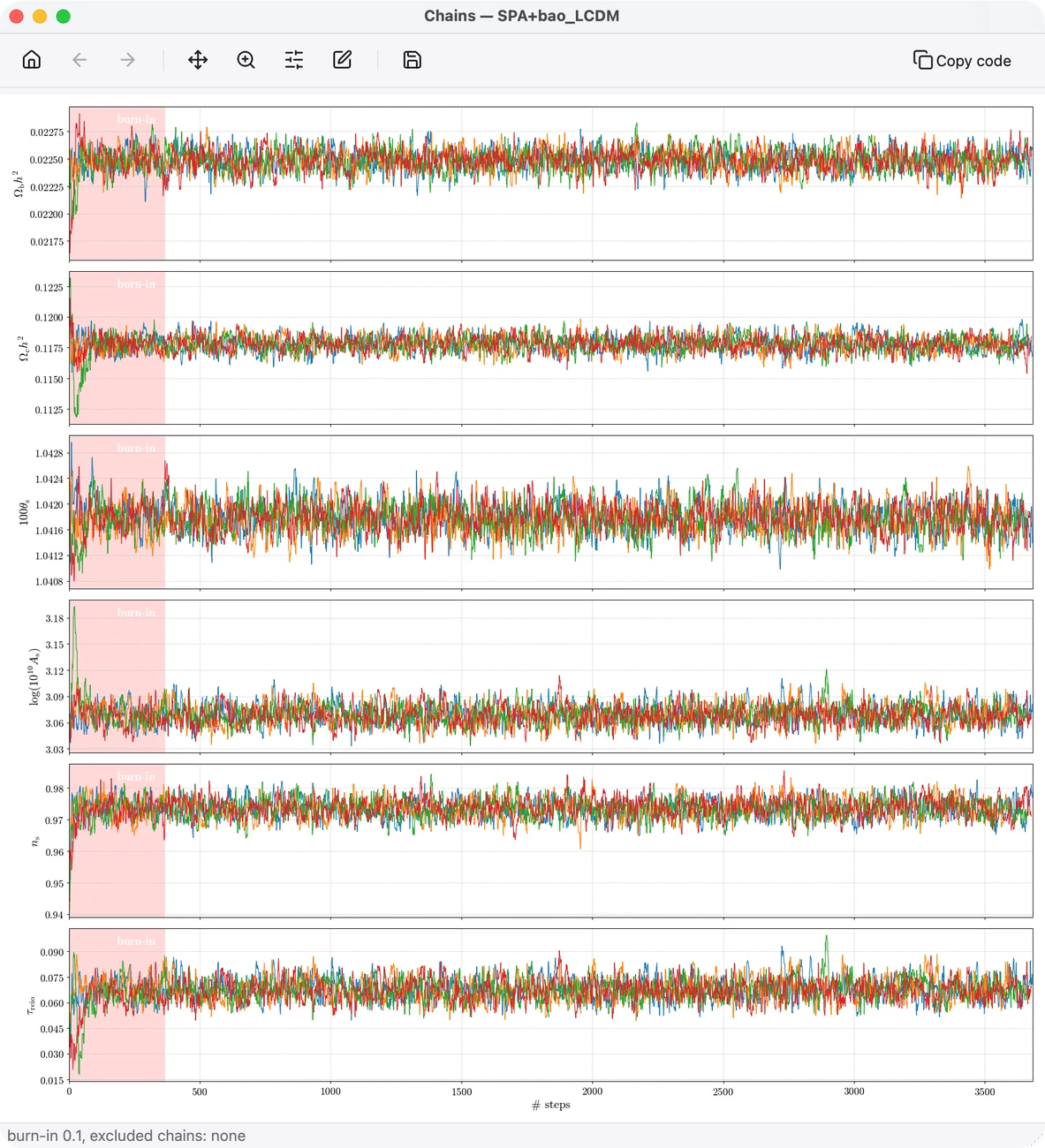
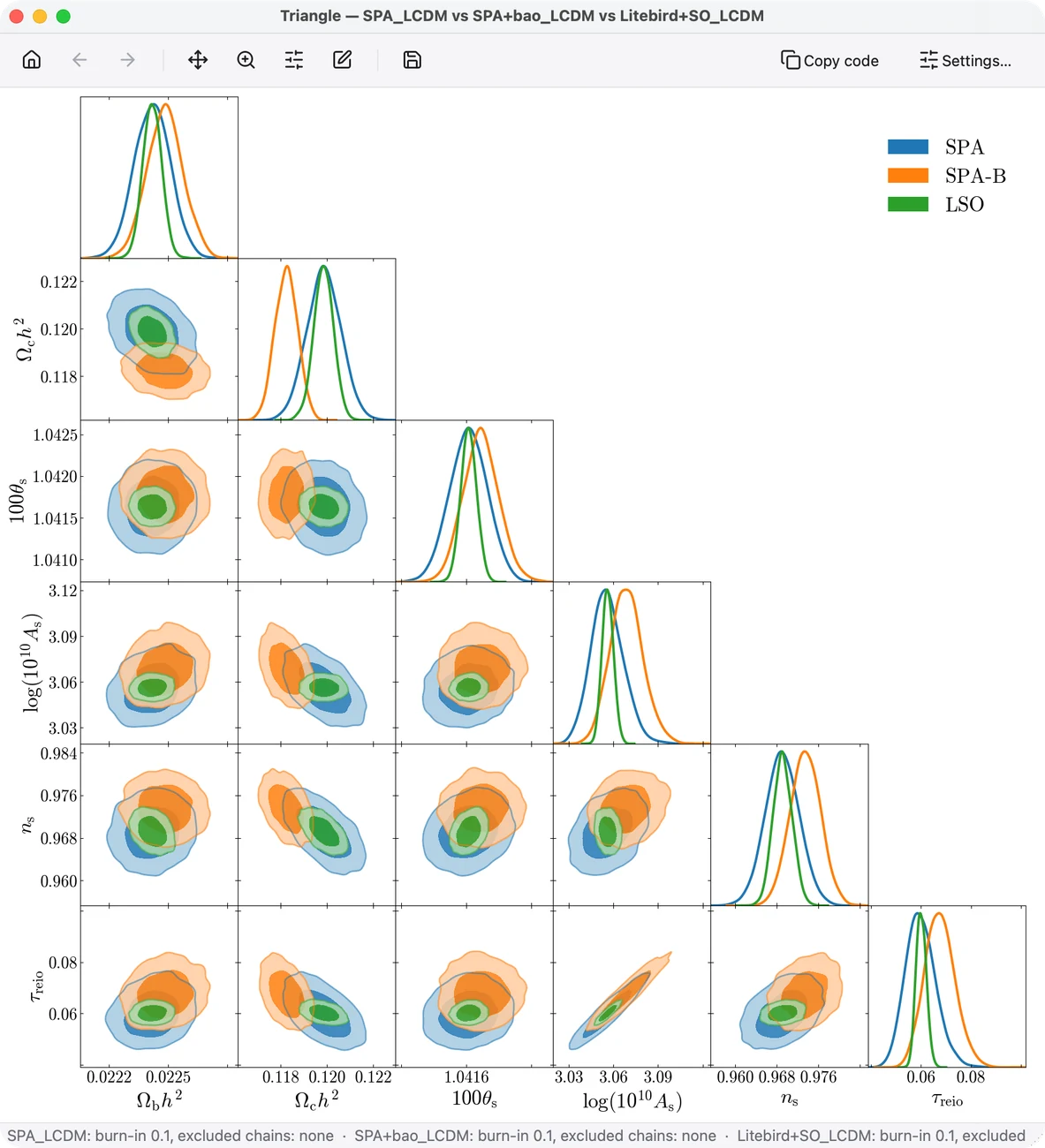
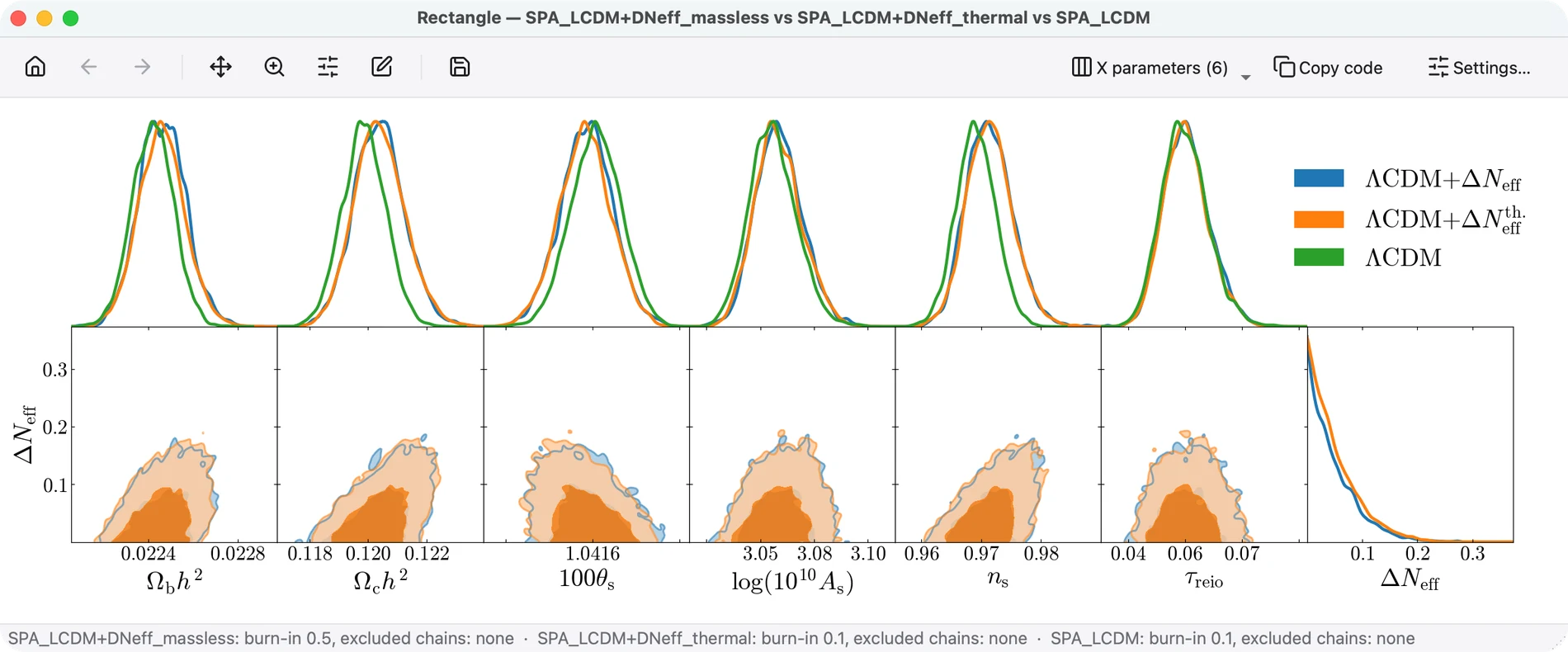
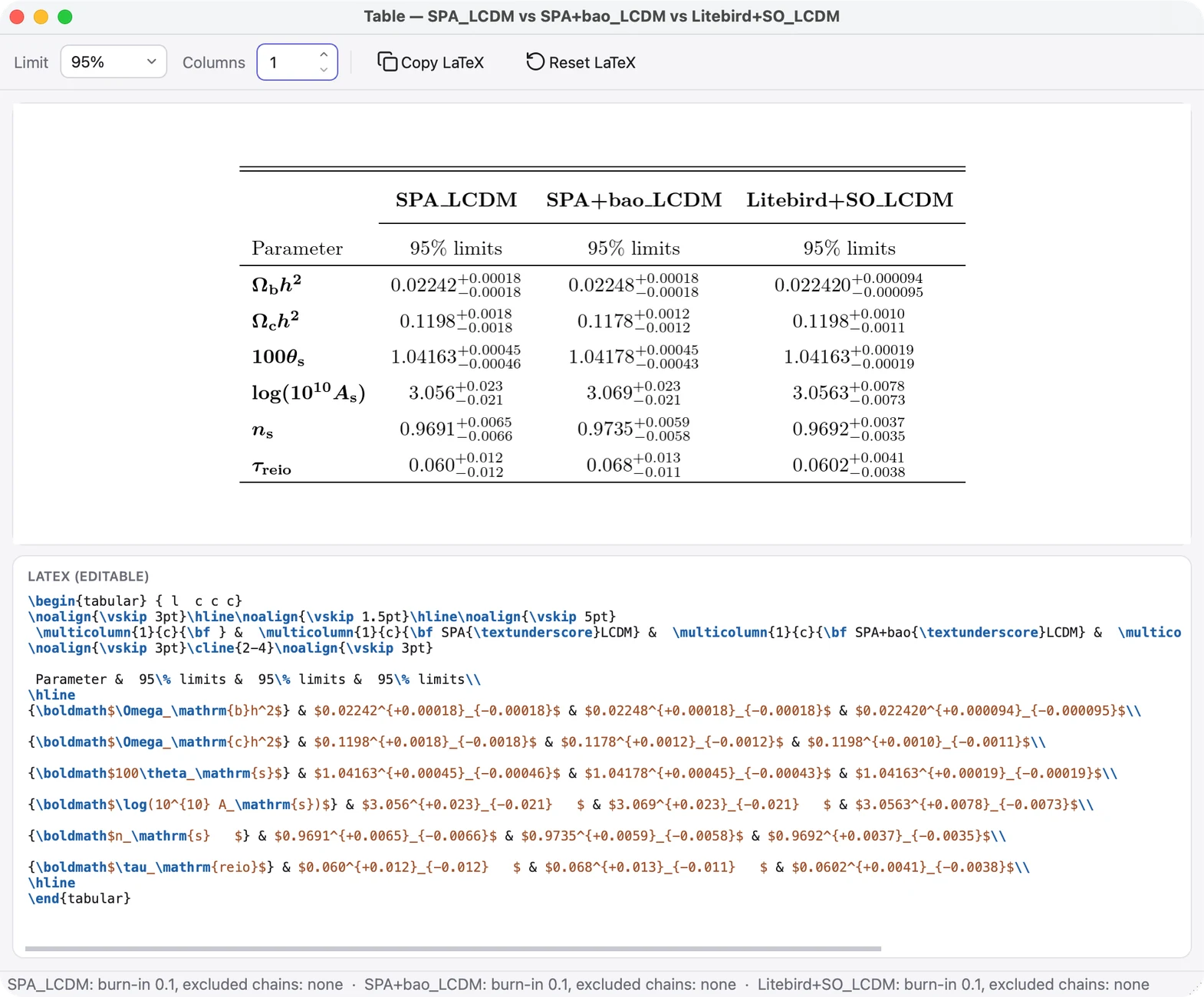
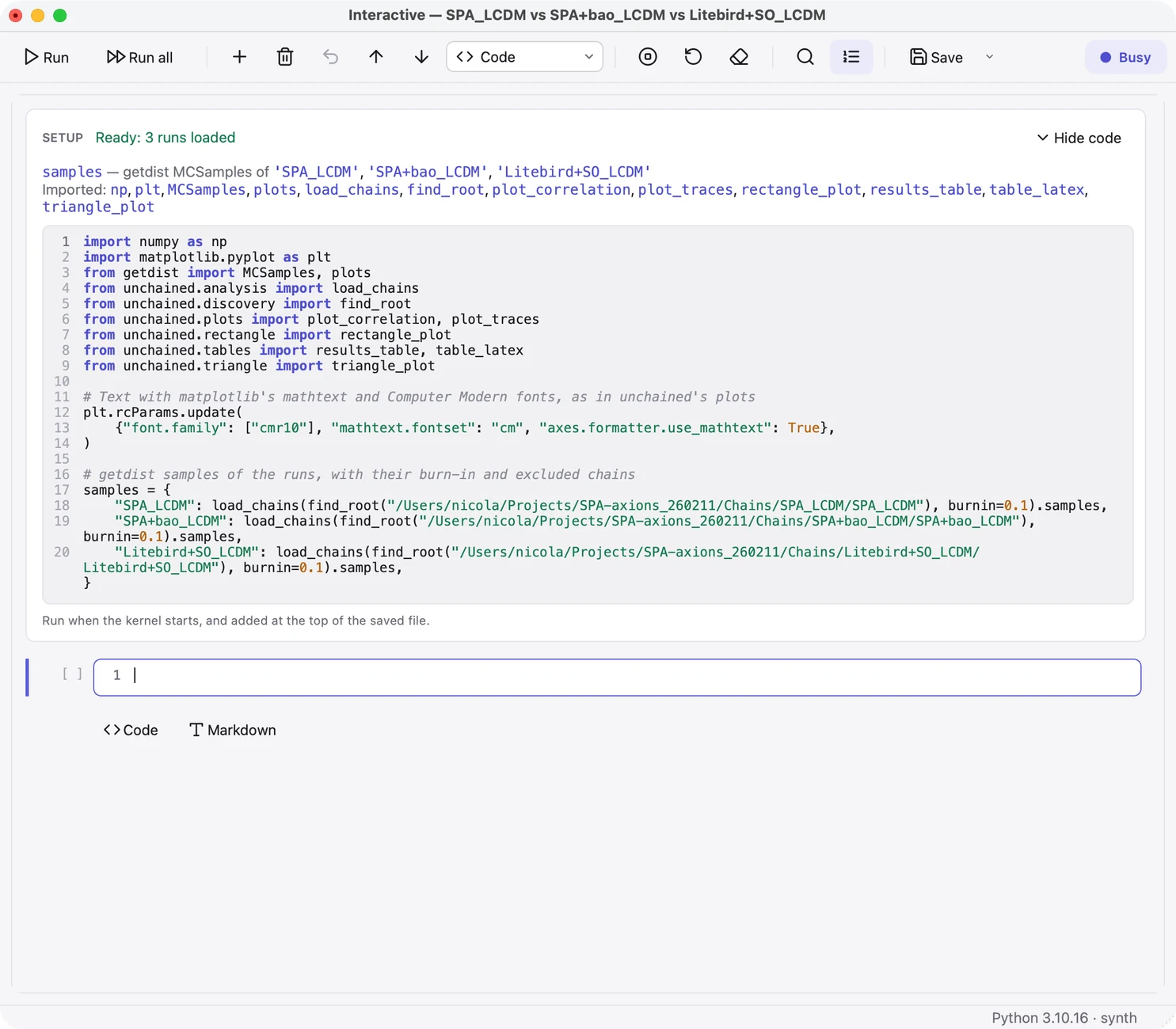
The runs found in a folder with their convergence status, and the details of the selected run. The chains plot of a run, with the burn-in marked. A triangle plot comparing three runs. A rectangle plot: some parameters against others, comparing three runs. A table of the constraints, rendered, with its LaTeX ready to edit. The interactive notebook, with the selected runs already loaded. Open a folder of chains and unchained lists the runs it finds, with their burn-in, R−1 and convergence status. From there you can set the burn-in, exclude chains, make plots and write tables. All the numbers are computed by getdist; unchained organises the runs and draws the results.
What it does
- Finds all the runs below a folder and shows which have converged
- Burn-in, exclusion of single chains, Gelman–Rubin R−1
- Trace, triangle and rectangle plots, of one run or several compared
- LaTeX tables of the constraints, with an editor and a preview
- Derived parameters defined by formulas
- An interactive Python notebook with the selected runs loaded
- Copies runs from a cluster with rsync over ssh
How it is built
Hover over a module to see what it does and how it connects. Click to read it.usesused by Your chains
- Cobaya MCMC
- Cobaya PolyChord
- MontePython MCMC
- A copy on a cluster
Finds and reads
Results
Where you use it
Desktop interface its main parts
Command line
Python
- your own scripts
- Reads
- Cobaya (MCMC, PolyChord) and MontePython (MCMC); other formats as plugins
- Runs on
- Python 3.10 or newer, on macOS and Linux
- Built on
- getdist, matplotlib and, for the interface, PySide6
- Citing
- Please cite getdist, which computes the results: arXiv:1910.13970
pip install "unchained[gui] @ git+https://github.com/nicolabarbieri/unchained_public"$ unchained scan path/to/chains /home/me/chains/ chains burn-in R-1 status from modified ├── lcdm 4 0.1 0.0047 converged getdist 2026-08-10 16:59 └── neff/ ├── neff_low 4 0.5 0.0213 not converged cobaya 2026-08-10 16:59 └── neff_high 4 0.1 0.0079 converged getdist 2026-08-10 16:59 3 runs found
cv
Curriculum vitae
Where I have studied and worked, and the rest of the record. Papers and talks have pages of their own.
Download PDF
Updated
Nicola Barbieri
Postdoctoral researcher, Instituto de Física Corpuscular (IFIC), CSIC – Universitat de València
nicola.barbieri@ific.uv.es
Positions
Nov 2025 – now
Postdoctoral researcher
Instituto de Física Corpuscular (IFIC), CSIC – Universitat de València
Theoretical astroparticle physics · PI: Dr. Sergio Pastor Carpi


Feb – Nov 2025
Research fellow (assegno di ricerca)
INFN, Sezione di Ferrara
Theoretical astroparticle physics · PI: Dr. Martina Gerbino


Education
2021 – 2024
Ph.D. in Physics
Department of Physics and Earth Sciences, University of Ferrara
Thesis: Tests of fundamental physics with cosmological observables
Supervisor: Dr. Massimiliano Lattanzi · co-supervisor: Dr. Martina Gerbino
2018 – 2021
M.Sc. in Physics, 110/110 cum laude
Department of Physics and Astronomy “Galileo Galilei”, University of Padova
Thesis: Testing non-standard neutrino interactions in cosmology
Supervisor: Prof. Nicola Bartolo · co-supervisors: Prof. Moslem Zarei, Dr. Massimiliano Lattanzi


2015 – 2018
B.Sc. in Physics, 110/110
Department of Physics and Astronomy “Galileo Galilei”, University of Padova
Thesis: Massive Fermi gas in the expanding Universe
Supervisor: Prof. Sabino Matarrese
Visiting periods
Feb – Jun 2024
Visiting Ph.D. student
IFIC, CSIC – Universitat de València
Supervisors: Dr. Olga Mena and Dr. Sergio Pastor Carpi
Grants & awards
2024
Short-Term Scientific Mission grant
COST Action CA21106 “Cosmic WISPers”
€2,000, awarded through competitive selection
2021
Merit scholarship
Alumni Association, Gregorianum University College, Padova
€1,000, for outstanding academic results
Collaborations
2022 – 2025
Atacama Cosmology Telescope (ACT)
External collaborator
Invited to contribute to the DR6 analysis on neutrino physics: extensions of ΛCDM with self-interacting neutrinos (Majoron models).
Teaching & supervision
2023
Bachelor’s thesis co-supervision
Giuseppe Giglio, University of Ferrara
L’inflazione cosmica e lo spettro delle perturbazioni primordiali, with Dr. Massimiliano Lattanzi
2019 – 2020
Physics tutor
University of Padova
Extra lectures on mechanics, fluid dynamics and thermodynamics for first-year Optics and Optometry students
2016 – 2017
Internal tutor
Istituto Superiore “Enrico Fermi”, Mantova
Interdisciplinary projects in chemistry, physics, data analysis and computing with final-year high-school students
Service
2022 – now
Referee
Journal of Cosmology and Astroparticle Physics (since 2022)
Physical Review D (since 2026)
Physical Review Letters (since 2026)
Physics of the Dark Universe (since 2026)
Jul 2024
Session co-chair
Seventeenth Marcel Grossmann Meeting (MG17), Pescara
Parallel session “Unveiling neutrino secrets through cosmology: current status and future developments”
Outreach
2023 – 2025
Aggiornamenti & Lab2Go
University of Ferrara and INFN
Lectures on software and hardware programming with mBlock and Arduino, for school teachers and high-school students
2022 – 2025
European Researchers’ Night
University of Ferrara and INFN
The Europe-wide science festival of the Marie Skłodowska-Curie actions, held in almost 400 cities
2022 – 2025
Stage Estivi @ UniFE
University of Ferrara and INFN
Summer labs for high-school students on Python, Google Colab and N-body simulations
2022 – 2025
Laboratori di Fisica Moderna
University of Ferrara and INFN
Labs on Python and cooperative problem solving about the thermal history of the Universe, for high-school students
Feb 2023, Feb 2025
Unife Orienta
University of Ferrara
Orientation sessions introducing new students to degree programmes and university services
Languages
Italian native
English fluent C1
Spanish elementary A2
beyond
Away from the blackboard
Music and films, mostly: the records I keep going back to, the movies I’ve watched recently, and a few transcriptions of mine. Press play on a record and it keeps playing while you look around the rest of the site. It’s all a bit empty for now, since the site is brand new, but there’s plenty more on the way.
Listening the library,
A few of my picks, to start with.
Movies the library,
Transcriptions all
beyond/movies
Movies
The films I keep going back to, and would send a friend to. Each opens on a page of its own; where there is a trailer, the round button plays it.
Nothing here matches.
beyond/transcriptions
Transcriptions
Scores I have written down by ear, to read or download.
Nothing here matches.
beyond/listening
Listening
The records I keep going back to, albums and single tracks. Press play on any of them; what is listed plays on, one after the other. An album opens on its own page, with its tracks.
Nothing here matches.
- Rating
- Tomatometer
- critics who liked it
- Metascore
- critics, on average
contact
Get in touch
Happy to talk about physics, collaborations or software, or anything else. I usually reply within a few days.
Profiles
- arXiv
barbieri_n_1
- INSPIRE-HEP
Nicola.Barbieri.1
- ORCID
0009-0007-7084-7564
- GitHub
@nicolabarbieri
- LinkedIn
nicola-barbieri
Office
Instituto de Física Corpuscular
CSIC – Universitat de València
Parc Científic, C/ Catedrático José Beltrán 2
46980 Paterna (València), Spain
Phone: (+34) 963 543 511
Office: B-5-6








CSIC – Universitat de València
Parc Científic, C/ Catedrático José Beltrán 2
46980 Paterna (València), Spain
Phone: (+34) 963 543 511
Office: B-5-6
References
-
Dr. Sergio Pastor Carpi
pastor@ific.uv.es IFIC, CSIC – Universitat de València
Parc Científic, C/ Catedrático José Beltrán 2
46980 Paterna (València), Spain
Phone: (+34) 963 543 474
Office: 1-3-3 -
Dr. Massimiliano Lattanzi
lattanzi@fe.infn.it INFN, Sezione di Ferrara
Via Giuseppe Saragat 1
44121 Ferrara, Italy
Phone: (+39) 0532 974 363
Office: 419, Blocco C